
ERUS Spotlight 2026: Advances in Robotic Kidney Surgery

Updated: Oct 3
Robotic surgery continues to develop rapidly, particularly in the treatment of complex kidney conditions. New imaging, surgical planning and robotic technologies are giving surgical teams increasingly detailed information before and during an operation. These developments were among the subjects discussed at ERUS Spotlight 2026, held during the 23rd Meeting of the EAU Robotic Urology Section in Padua, Italy.
Dr Carlo Bravi joined the ERUS Spotlight Day 2 panel as a moderator, contributing to an international expert discussion on robot-assisted partial nephrectomy and complex robotic kidney surgery with pre-operative simulation.
What Is ERUS?
ERUS is the EAU Robotic Urology Section of the European Association of Urology. Its annual meeting brings together urological surgeons and other healthcare professionals with a specialist interest in robotic surgery.

The programme combines live and recorded surgical procedures, case discussions, scientific presentations and debates about emerging surgical techniques and technologies. These meetings provide an opportunity for specialists to examine how robotic surgery is evolving, discuss challenging cases and consider how new technology may be incorporated safely into clinical practice.
The Focus of ERUS Spotlight Day 2
The second ERUS Spotlight session focused on two robotic kidney procedures:
Robot-assisted partial nephrectomy
Complex partial nephrectomy supported by pre-operative simulation
The session brought together international specialists to discuss the technical and clinical considerations involved in these operations. Dr Bravi participated as one of the session moderators, helping guide the discussion around surgical planning, decision-making and the management of complex renal tumours.
The complete ERUS Spotlight Day 2 session is available to watch on SurgQuest.
The recording includes the international expert discussion moderated by Dr Carlo Bravi on robot-assisted partial nephrectomy, complex kidney surgery and pre-operative simulation. Access to the full video requires a free SurgQuest account, which can be created using an email address.
Watch ERUS Spotlight Day 2 on SurgQuest. For the official meeting report, including details of the moderators, surgeons and procedures discussed, visit the ERUS26 Spotlight Session: Day 2 page.
What Is a Robotic Partial Nephrectomy?
A partial nephrectomy is an operation in which a kidney tumour is removed while preserving as much healthy kidney tissue as reasonably possible. The procedure may be considered for selected patients with a localised kidney mass. Suitability depends on several factors, including:
The size and position of the mass, and its relationship to blood vessels and the kidney’s drainage system
The function of both kidneys
The patient’s overall health and previous abdominal surgery
The potential benefits and risks of alternative treatments
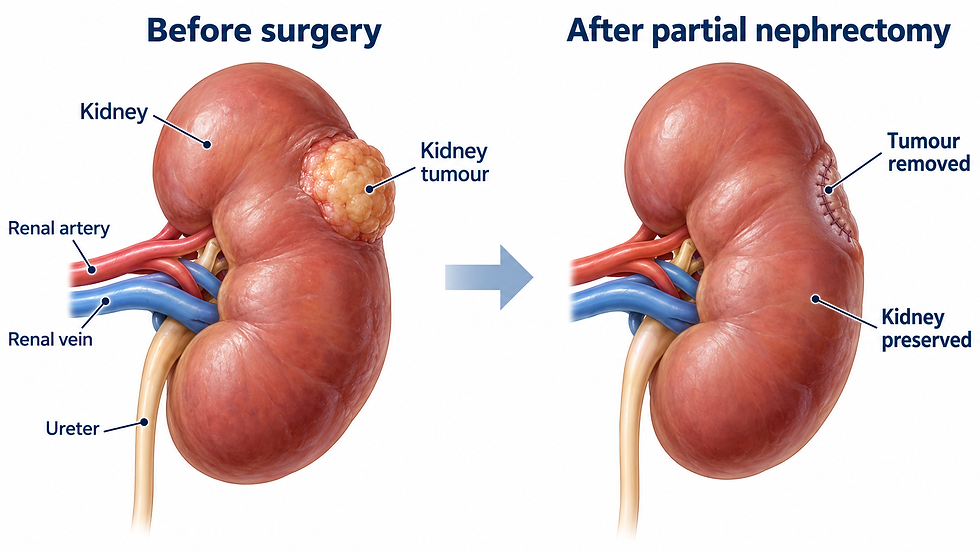
During a robotic partial nephrectomy, the surgeon operates through several small abdominal incisions. The robotic instruments remain entirely under the surgeon’s control and provide a magnified three-dimensional view of the operative area.
The principal aim is to remove the tumour with an appropriate margin while preserving functioning kidney tissue whenever this is oncologically safe and technically possible.
Why Can Kidney Surgery Be Complex?
Kidney tumours vary considerably in their size, position and relationship to surrounding structures. Some masses are located close to major blood vessels or to the collecting system through which urine drains from the kidney. Others may grow partly or predominantly within the kidney, making their boundaries more difficult to identify from the external surface. These anatomical differences can influence whether partial nephrectomy is appropriate and how the operation should be planned.
A careful assessment of CT or MRI imaging is therefore essential before surgery. In more complex cases, additional planning tools may help the surgical team better understand the relationship between the tumour and the surrounding anatomy.
What Does This Mean for Patients?
The development of robotic surgery is not simply about introducing new technology. The important question is whether that technology helps clinicians plan and perform an appropriate operation safely and effectively.
For patients with a kidney mass, the first step remains an individual assessment. Not every kidney mass requires surgery, and robotic partial nephrectomy is not suitable for every patient. Management options may include surveillance, biopsy, thermal ablation, partial nephrectomy or removal of the entire kidney. The appropriate approach depends on the characteristics of the mass, kidney function, general health and the patient’s individual priorities.
A specialist consultation allows the available imaging to be reviewed and the potential advantages, limitations and risks of each option to be discussed.
Dr Carlo Bravi and Robotic Urological Surgery
Dr Carlo Bravi is a consultant urologist with specialist experience in robotic and minimally invasive surgery for prostate and kidney conditions. His participation in ERUS Spotlight reflects his continuing involvement in international professional discussion and education relating to robotic urological surgery.
Further information about Dr Bravi’s conference participation, presentations and professional interviews is available in the Media section. You can also learn more about robotic urological surgery and the assessment of kidney masses.
If you have been diagnosed with a kidney mass, are considering robotic kidney surgery or would like a specialist second opinion, Dr Carlo Bravi offers private consultations in Northampton and London.
During your consultation, your imaging and clinical history can be reviewed, allowing the available treatment options and the potential role of robotic surgery to be discussed according to your individual circumstances.
To ask about availability or arrange an appointment, please contact Dr Carlo Bravi.
This article provides general information and does not replace individual medical advice.


Comments